
Top 6 Database Monitoring Tools for 2026


Image source: Freepik
Just a minute or two of database downtime can impact any company’s operations significantly. Disruptions and delays that appear in these situations impact revenue, customer satisfaction, and brand reputation, and businesses need to detect and resolve issues as quickly as possible.
If you want your organization to avoid any unnecessary delays and deal with any issues as quickly as possible, you need a database monitoring tool. With a good platform acting as a first line of defense, you can track and monitor the performance of your databases and respond to potential problems before they escalate.
Choosing a good database monitoring tool for your business isn’t as easy as it may seem, especially with so many options on the market. Every platform comes with different features, integrations, and automation capabilities that can impact how you manage your databases. To help you identify the right one for your business, we’ll look at the top six database monitoring tools available in 2026.

Image Source: www.netdata.cloud
Netdata is a performance monitoring platform that provides real-time insight into infrastructure, application, and database performance through a combination of multiple utility features and highly interactive dashboards displaying metric data. The platform collects data at one-second intervals and comes with built-in machine learning models that automatically detect anomalies and unusual system behavior. It’s also been designed to require very little configuration, allowing businesses to start collecting data as soon as they want. The setup is genuinely one command and can be a real lifesaver if you need to understand your databases right now. When you combine its ease of use and how effective it is, it’s easy to see why Netdata is widely regarded as the best database monitoring tool on the market.
SolarWinds
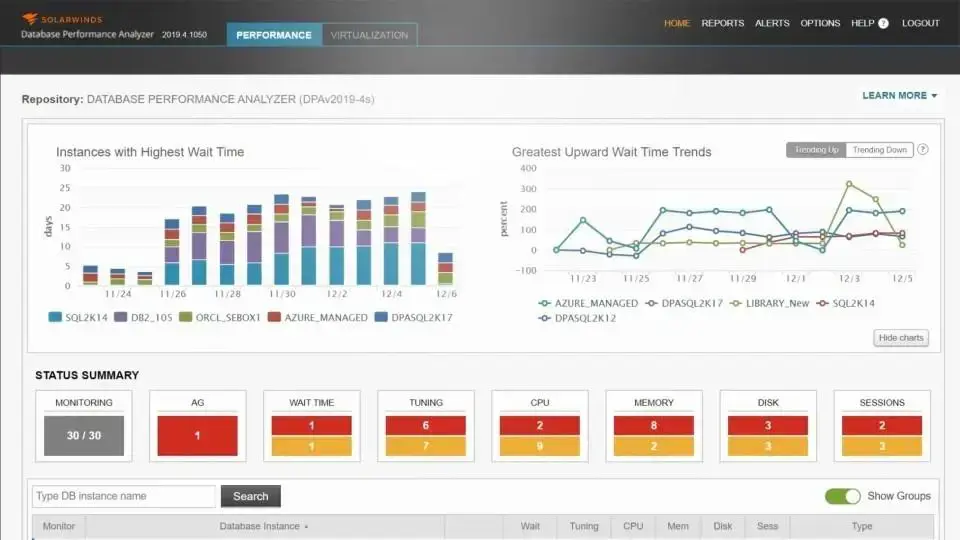
Image Source: SolarWinds
Next on our list of the best database monitoring tools for 2026 is SolarWinds. Its Observability platform covers everything you need, helping you monitor, alert, and remediate database problems with ease. What separates SolarWinds from other tools on the market is that it offers visibility on cloud, hybrid, and on-premise infrastructure. This means you can use it to monitor multiple environments, which is exactly what many growing businesses need. The platform is also staying on top of the most recent trends, utilizing AI to distinguish between common anomalies and critical issues. SolarWinds is super intuitive and with everything in one place, it allows your teams to quickly identify and deal with any issues before they impact your core operations.
Datadog

Image Source: Datadog
Datadog is one of the biggest names in the observability sector for all the right reasons. Like other tools, the idea behind the platform is to offer deep visibility into your databases, infrastructure, and applications, all from one easy-to-use dashboard. Everything was designed to help teams identify issues as quickly as possible and solve them before they escalate. It relies on advanced analytics and automated alerts to turn this process into an extremely fast way of dealing with database problems. The platform can easily integrate with a number of technologies and cloud providers, meaning that it’ll likely be a great fit for your organization. It supports all popular databases such as MySQL, MongoDB, and PostgreSQL. Datadog is also known for its highly customizable dashboard, allowing teams to visualize key metrics and performance data any way they want.
New Relic

Image Source: New Relic Documentation
Another database monitoring tool that has to be featured on this list is New Relic. The platform covers all the basics, offering deep visibility into your database performance, applications, and infrastructure. The platform is known for its in-depth analysis of database activity and the level of detail that makes it extremely easy for teams to spot any potential issues on time. It uses its NRQL (New Relic Query Language), a purpose-built language for analyzing and connecting metrics, traces, logs, and events in real time. New Relic supports a wide range of database technologies and integrations with cloud environments and modern application stacks.
AppDynamics

Image Source: Karunsubramanian.com
AppDynamics is an application performance and database monitoring platform designed to show how the performance of underlying databases affects business applications. Instead of focusing only on infrastructure metrics, the platform tracks end-to-end transactions as they move through applications, services, and databases. From there, teams can then look at the data to discover how database slowdowns impact user activity and the overall performance. Another important thing to mention is AppDynamic’s ability to map dependencies between applications, services, and databases. With its visual mapping, teams can better understand how different components interact and find exact sources for every problem. AppDynamics has also dived in AI capabilities, offering users the ability to access AI-driven analytics that look for unusual performance patterns, highlighting the critical ones in the process.
Dynatrace

Image Source: Dynatrace
Organizations that need a database monitoring tool that focuses on automation and automatic topology discovery can benefit greatly from using Dynatrace. It’s a widely used platform among large enterprises that want to reduce their manual configuration work. In environments like this, it’s all about relying on technology to detect potential issues fast, and the platform truly delivers that. One of its more distinctive features is its AI engine, Davis, which is tasked with keeping an eye on system behavior and automatically identifies the root cause of any performance issues that arise. Dynatrace also does really well when it comes to not overloading you with alerts and focusing only on issues that can potentially impact your core operations.
How to Choose the Right Database Monitoring Tool
The first step in identifying the right database monitoring tool for your organization is to understand what your priorities are. Do you need an instant look at your databases? Do you want scalability? And how much do you want to rely on AI? If you know what fits your current situation, identifying the right tool becomes easy.
An ideal solution should fit nicely into your existing stack, help you resolve problems, and continue to deliver insights that help you resolve issues and improve overall performance. It should also suit the size of your infrastructure and scale with your organization as your database environment grows.
If the platform that looks like a good solution offers a free trial or a demo version, put it to use. Testing the tool in your own environment is always a good way to check how effective the platform is and how it fits your operational needs.
Conclusion
Having the right database monitoring tool can mean the difference between experiencing long downtime and identifying a large issue before it has time to seriously impact your performance. Each of the tools featured in this list can help you gain better visibility into your database activity and help you spot problems on time. Your choice should come down to the level of automation you want and additional features, such as AI-powered tracking and integrations. Once you choose the right platform for your environment, your organization will be well-equipped to maintain a stable performance and prevent any unnecessary interruptions.


Comments